
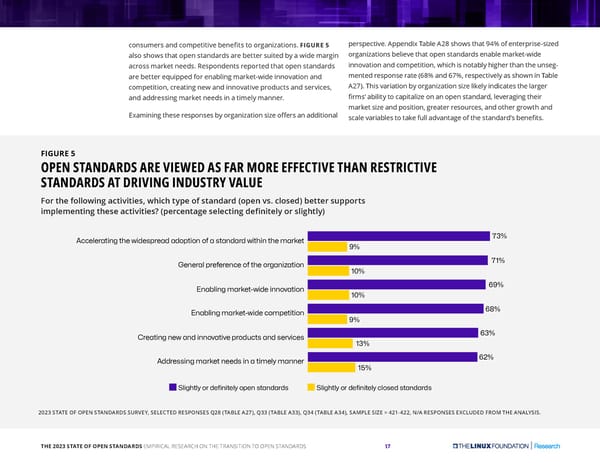
consumers and competitive benefits to organizations. FIGURE 5 perspective. Appendix Table A28 shows that 94% of enterprise-sized also shows that open standards are better suited by a wide margin organizations believe that open standards enable market-wide across market needs. Respondents reported that open standards innovation and competition, which is notably higher than the unseg- are better equipped for enabling market-wide innovation and mented response rate (68% and 67%, respectively as shown in Table competition, creating new and innovative products and services, A27). This variation by organization size likely indicates the larger and addressing market needs in a timely manner. firms’ ability to capitalize on an open standard, leveraging their market size and position, greater resources, and other growth and Examining these responses by organization size offers an additional scale variables to take full advantage of the standard’s benefits. FIGURE 5 OPEN STANDARDS ARE VIEWED AS FAR MORE EFFECTIVE THAN RESTRICTIVE STANDARDS AT DRIVING INDUSTRY VALUE For the following activities, which type of standard (open vs. closed) better supports implementing these activities? (percentage selecting definitely or slightly) 73% Acc�l�rating th� �id��pr�ad adoption o� a �tandard �ithin th� mark�t 9% 71% G�n�ral pr���r�nc� o� th� organization 10% 69% Enabling mark�t-�id� innovation 10% 68% Enabling mark�t-�id� comp�tition 9% 63% Cr�ating n�� and innovativ� product� and ��rvic�� 13% 62% Addr���ing mark�t n��d� in a tim�ly mann�r 15% Slightly or d��init�ly op�n �tandard� Slightly or d��init�ly clo��d �tandard� 2023 STATE OF OPEN STANDARDS SURVEY, SELECTED RESPONSES Q28 (TABLE A27), Q33 (TABLE A33), Q34 (TABLE A34), SAMPLE SIZE = 421-422, N/A RESPONSES EXCLUDED FROM THE ANALYSIS. THE 2023 STATE OF OPEN STANDARDS EMPIRICAL RESEARCH ON THE TRANSITION TO OPEN STANDARDS 17
 The 2023 State of Open Standards Page 16 Page 18