
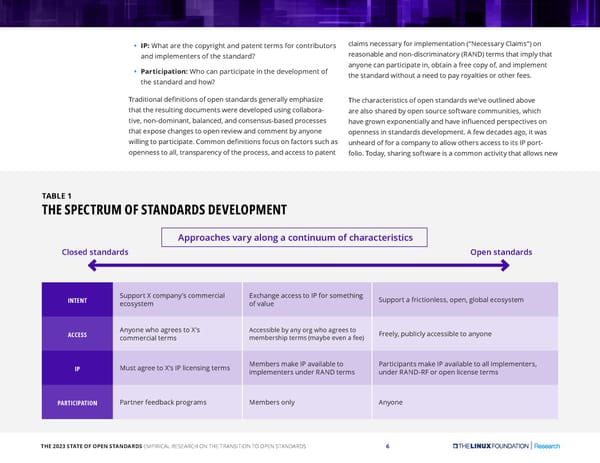
• IP: What are the copyright and patent terms for contributors claims necessary for implementation (“Necessary Claims”) on and implementers of the standard? reasonable and non-discriminatory (RAND) terms that imply that • Participation: Who can participate in the development of anyone can participate in, obtain a free copy of, and implement the standard and how? the standard without a need to pay royalties or other fees. Traditional definitions of open standards generally emphasize The characteristics of open standards we’ve outlined above that the resulting documents were developed using collabora- are also shared by open source software communities, which tive, non-dominant, balanced, and consensus-based processes have grown exponentially and have influenced perspectives on that expose changes to open review and comment by anyone openness in standards development. A few decades ago, it was willing to participate. Common definitions focus on factors such as unheard of for a company to allow others access to its IP port- openness to all, transparency of the process, and access to patent folio. Today, sharing software is a common activity that allows new TABLE 1 THE SPECTRUM OF STANDARDS DEVELOPMENT Approaches vary along a continuum of characteristics Open standards Closed standards INTENT Support X company’s commercial Exchange access to IP for something Support a frictionless, open, global ecosystem ecosystem of value ACCESS Anyone who agrees to X’s Accessible by any org who agrees to Freely, publicly accessible to anyone commercial terms membership terms (maybe even a fee) IP Must agree to X’s IP licensing terms Members make IP available to Participants make IP available to all implementers, implementers under RAND terms under RAND-RF or open license terms PARTICIPATION Partner feedback programs Members only Anyone THE 2023 STATE OF OPEN STANDARDS EMPIRICAL RESEARCH ON THE TRANSITION TO OPEN STANDARDS 6
 The 2023 State of Open Standards Page 5 Page 7