
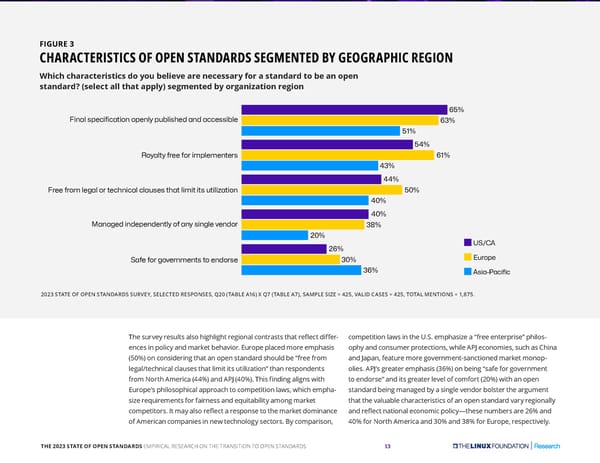
FIGURE 3 CHARACTERISTICS OF OPEN STANDARDS SEGMENTED BY GEOGRAPHIC REGION Which characteristics do you believe are necessary for a standard to be an open standard? (select all that apply) segmented by organization region 65% Final �p�ci�ication op�nly publi�h�d and acc���ibl� 63% 51% 54% Royalty �r�� �or impl�m�nt�r� 61% 43% 44% 50% Fr�� �rom l�gal or t�chnical clau��� that limit it� utilization 40% 40% �anag�d ind�p�nd�ntly o� any �ingl� v�ndor 38% 20% 26% US/CA 30% Europ� Sa�� �or gov�rnm�nt� to �ndor�� 36% A�ia-Paci�ic 2023 STATE OF OPEN STANDARDS SURVEY, SELECTED RESPONSES, Q20 (TABLE A16) X Q7 (TABLE A7), SAMPLE SIZE = 425, VALID CASES = 425, TOTAL MENTIONS = 1,875. The survey results also highlight regional contrasts that reflect differ- competition laws in the U.S. emphasize a “free enterprise” philos- ences in policy and market behavior. Europe placed more emphasis ophy and consumer protections, while APJ economies, such as China (50%) on considering that an open standard should be “free from and Japan, feature more government-sanctioned market monop- legal/technical clauses that limit its utilization” than respondents olies. APJ’s greater emphasis (36%) on being “safe for government from North America (44%) and APJ (40%). This finding aligns with to endorse” and its greater level of comfort (20%) with an open Europe’s philosophical approach to competition laws, which empha- standard being managed by a single vendor bolster the argument size requirements for fairness and equitability among market that the valuable characteristics of an open standard vary regionally competitors. It may also reflect a response to the market dominance and reflect national economic policy—these numbers are 26% and of American companies in new technology sectors. By comparison, 40% for North America and 30% and 38% for Europe, respectively. THE 2023 STATE OF OPEN STANDARDS EMPIRICAL RESEARCH ON THE TRANSITION TO OPEN STANDARDS 13
 The 2023 State of Open Standards Page 12 Page 14