
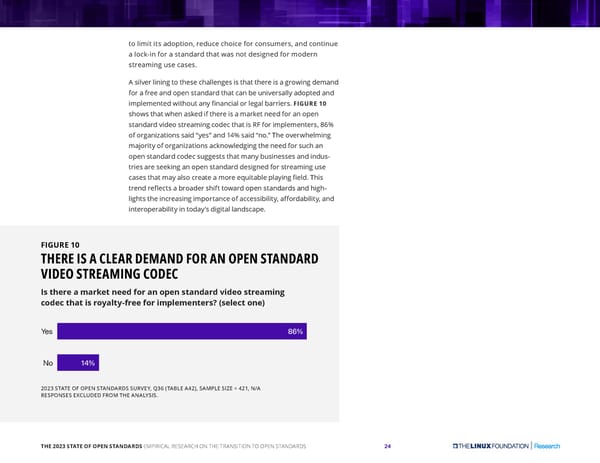
to limit its adoption, reduce choice for consumers, and continue a lock-in for a standard that was not designed for modern streaming use cases. A silver lining to these challenges is that there is a growing demand for a free and open standard that can be universally adopted and FIGURE 10 implemented without any financial or legal barriers. shows that when asked if there is a market need for an open standard video streaming codec that is RF for implementers, 86% of organizations said “yes” and 14% said “no.” The overwhelming majority of organizations acknowledging the need for such an open standard codec suggests that many businesses and indus- tries are seeking an open standard designed for streaming use cases that may also create a more equitable playing field. This trend reflects a broader shift toward open standards and high- lights the increasing importance of accessibility, affordability, and interoperability in today’s digital landscape. FIGURE 10 THERE IS A CLEAR DEMAND FOR AN OPEN STANDARD VIDEO STREAMING CODEC Is there a market need for an open standard video streaming codec that is royalty-free for implementers? (select one) Y�� 86% No 14% 2023 STATE OF OPEN STANDARDS SURVEY, Q36 (TABLE A42), SAMPLE SIZE = 421, N/A RESPONSES EXCLUDED FROM THE ANALYSIS. THE 2023 STATE OF OPEN STANDARDS EMPIRICAL RESEARCH ON THE TRANSITION TO OPEN STANDARDS 24
 The 2023 State of Open Standards Page 23 Page 25