
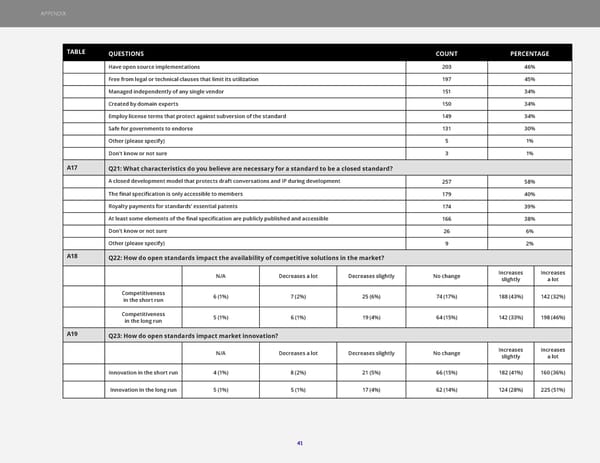
APPENDIX TABLE QUESTIONS COUNT PERCENTAGE Have open source implementations 203 46% Free from legal or technical clauses that limit its utilization 197 45% Managed independently of any single vendor 151 34% Created by domain experts 150 34% Employ license terms that protect against subversion of the standard 149 34% Safe for governments to endorse 131 30% Other (please specify) 5 1% Don’t know or not sure 3 1% A17 Q21: What characteristics do you believe are necessary for a standard to be a closed standard? A closed development model that protects draft conversations and IP during development 257 58% The final specification is only accessible to members 179 40% Royalty payments for standards’ essential patents 174 39% At least some elements of the final specification are publicly published and accessible 166 38% Don’t know or not sure 26 6% Other (please specify) 9 2% A18 Q22: How do open standards impact the availability of competitive solutions in the market? Increases Increases N/A Decreases a lot Decreases slightly No change slightly a lot Competitiveness 6 (1%) 7 (2%) 25 (6%) 74 (17%) 188 (43%) 142 (32%) in the short run Competitiveness 5 (1%) 6 (1%) 19 (4%) 64 (15%) 142 (33%) 198 (46%) in the long run A19 Q23: How do open standards impact market innovation? Increases Increases N/A Decreases a lot Decreases slightly No change slightly a lot Innovation in the short run 4 (1%) 8 (2%) 21 (5%) 66 (15%) 182 (41%) 160 (36%) Innovation in the long run 5 (1%) 5 (1%) 17 (4%) 62 (14%) 124 (28%) 225 (51%) 41
 The 2023 State of Open Standards Page 40 Page 42